How Much Do Amazon Influencers Make? What Fewer Videos Taught Me
So if you searched "how much do Amazon influencers make," you've probably found a lot of screenshots of someone's best month ever, and not much else. That's not really the answer to the question. The real answer is messier, and honestly more useful, because it shows you what actually happens to this income over years, not just a highlight reel.
I've got my full spreadsheet from 2023 through this year, and I'm going to walk you through what it actually looked like. If you haven't read about how I actually got into the program in the first place, what it takes to get approved and what those first shoppable videos need to look like is worth reading first, this post picks up right where that one leaves off.
The year-by-year numbers
In 2023, my first year, I uploaded 191 videos and made $1,888.60.
In 2024, I uploaded 43 videos. Way fewer, less than a quarter of the year before. And I made $4,381.36.
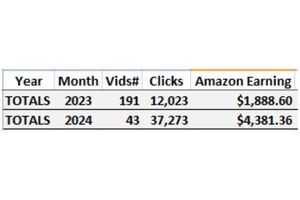
Read that again. Fewer videos, more than double the money. That's the thing nobody explains when they're talking about follower counts and requirements. Once a video is up and it's earning, it keeps earning, as long as that product is still selling and someone actually watches your video before they buy.
Why I slowed down
Here's the honest part. I didn't slow down because I found some secret shortcut. I got a little burned out on filming, and I got busy. I was working on getting my knitting YouTube channel monetized, starting a knitting blog, and I'd also started reposting my shoppable videos onto a new YouTube review channel, which comes with its own pile of work, writing SEO titles, descriptions, adding end screens, adding affiliate links. That's not free time, that's a whole second job layered on top of the first one.
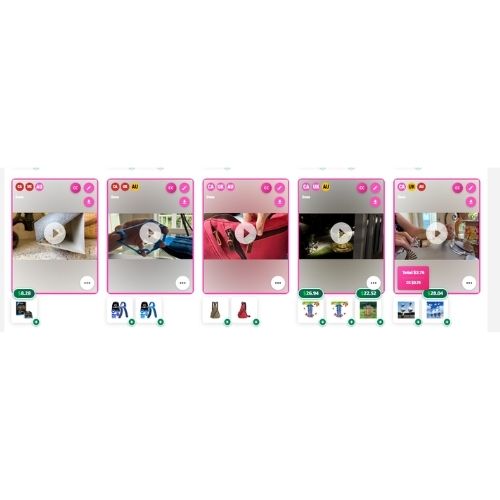
So really, it came down to how much hustle I had in me at any given point, and where I wanted to spend it. I saw my older videos were still performing, so I let myself get pickier about what I filmed instead of grinding out volume just to grind. If you're wondering whether this only works if you keep pumping out videos forever, no. It doesn't have to. But it does mean the growth slows down when you do.
The part you can't control: carousel rotation
Here's something that took me a while to understand and honestly, I've mostly made peace with not understanding it fully. Amazon rotates which videos show up in a product's video carousel, and you don't get a say in it.
If you're completely new to this, you might not even know what a carousel is. On every Amazon product page, there may or may not be a spot for videos. Sometimes the brand hasn't even turned that feature on, so no videos show up there at all. But when it is turned on, there's usually a top carousel, and landing there gives you a good shot at your video actually being seen and you making a commission. There's also a bottom carousel, tucked between the end of the product information and the customer reviews, which remember, is a completely different thing than a shoppable video. Amazon decides which spot, if any, your video lands in. You don't request it and you can't control it.
There are tools that'll tell you if your video is currently sitting in one of those carousels, and that's really the only way you make a commission, unless Amazon happens to use your content somewhere else on the site, but they don't tell you where that is either.
I remember watching one product make consistent sales for months, then suddenly nothing. I checked, and sure enough, my video had dropped out of the rotation. Then a while later, it started earning again, on its own, with nothing I did differently. I've also noticed one buyer might see a completely different set of videos in that carousel than the next buyer looking at the exact same product. In the beginning I tried tracking where every video showed up. Eventually that felt pointless, so I stopped obsessing over it. Now I'll glance at a few now and then, but I don't lose sleep over it.
Keeping ASINs alive
The other maintenance piece is ASINs (pronounced ACE-in), every product on Amazon, is assigned and ID. That product ID number gets tied to your video. Sometimes a product you're earning on just disappears, not because it stopped selling, but because the seller changed and the product got a brand new ASIN under a different seller, sometimes even under a slightly different brand name for the exact same item.
In the early days I kept an eye on this manually through my spreadsheet, noticing when something stopped selling and hunting around for the same product listed under a new seller. It was hit or miss.
Now I use a tool called OINK that runs a search for dead ASINs and hands me a list, so I'm not hunting blind anymore. I will be going into more details about this software in future posts, so keep an eye open. Even then, it's not a straight swap every time. If a product's just temporarily out of stock and I'm sitting in a good spot in that carousel, I'll actually leave it alone and wait to see if it comes back in stock, because pulling that ASIN and replacing it could cost me my spot in rotation. If it looks like it's really gone for good, then I'll risk the change. Sometimes I'll even tag the same product under two different ASINs if the same item genuinely exists under both. I try not to go past three tags on any one video though, it starts getting messy past that.
So, is it worth it?
Here's where I land after three years of watching these numbers. This isn't passive income in the way people picture passive income. It needs some ongoing maintenance, checking carousels here and there, keeping ASINs fresh, deciding when to leave something alone and when to fix it. But it's also not a hamster wheel where you have to keep producing at the same pace forever just to keep the lights on. My video uploading dropped by more than three-quarters and my income more than doubled the very next year.
There's more to this story though. In 2024, something else kicked in that had a real hand in that jump, a program called Creator Connections, and a tool that ended up finding me money I wouldn't have found on my own. And there's a change Amazon made to commissions this year that I need to be honest with you about, because it changes some of the math I just walked you through. Both of those get their own post. Come back for those next.
And if you're starting from scratch and wondering what it actually takes to get into the program in the first place, that's covered in Amazon Influencer Program Requirements: What It Actually Takes.